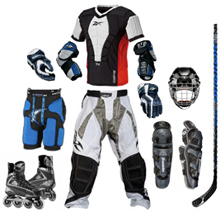
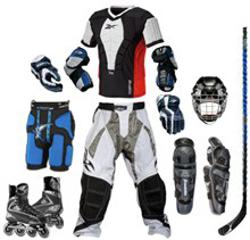
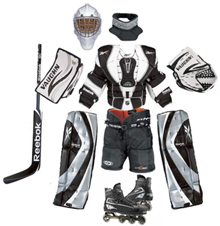
Roller hockey - or inline hockey - and ice hockey are very similar with a few distinct differences in rules and equipment. With roller hockey, the game is played four on four instead of the traditional five on five. Roller hockey can be played at a much faster pace due to the no hitting, icing, or offside rules.
Check out this video from the Alberta Minor Hockey Association about the sport of roller hockey:
https://youtu.be/3nsJBiNdbFE
Roller Hockey Gear Explanation
Hockey helmets with a full face cage or shield are required.
Hockey and insurance rules require that you wear a CSA and HECC currently certified helmet (indicated by a sticker on the back of the helmet). A helmet should fit snugly to maximize protection, but the helmet should still fit comfortably. Helmets are adjustable for a precise fit with certain helmets offering multiple adjustment points. Face masks usually provide the best fit when they're the same size as the helmet. Correct helmet sizing is imperative to maximize protection. Face masks must be worn with clips on the side of the helmet to allow the mask to protect the jaw. To properly fit a helmet, one must measure in inches the circumference of the player’s head approximately 1" above the eye brows. This length will aid in the proper sizing of the helmet. Then follow the manufacturer’s sizing guidelines.
Upper Body Protection
For RDRH youth hockey players, shoulder pads are optional. There are players however, that feel more comfortable and protected wearing a padded shirt. These are breathable stretch shirts with pieces of foam and/or hard plastic shells inserted.
Hockey Elbow Pads
Hockey elbow pads are required. Elbow pads are obviously worn to protect your elbows, but they also provide protection for your upper forearms and lower biceps/triceps. They should fit over your elbow snugly and extend up to the middle of the bicep and down to the middle of the forearm, ideally meeting the cuff of the glove. Most brands indicate right and left sides.
Hockey Gloves
Hockey gloves are required. Gloves are the same as shin guards in the sense there is no difference between ice hockey and inline gloves.
In order to find your glove size you need to measure from the base of your middle finger on the palm side of your hand up to the crease of your elbow. This is probably the best method available, apart from actually trying on the gloves. Take into account that if you have proportionally longer or shorter fingers than normal then you may need to go up or down 1" in order to get the best fit. Also, certain models run bigger/smaller than standard so you'll want to keep that in mind as well. In most cases, the method that we recommended is very accurate and ought to work well across the board. From one manufacturer to the next there's a fairly good degree of consistency.
Hockey / Inline Girdle
Inline girdles are more lightweight and cooler than ice girdles. There may not be legal checking, but this is still a contact sport and collisions do happen. Most inline girdles have a jock built in and many also come with a cup. Cups are required for male players, pelvic protectors are encouraged but optional for female players.
To determine size and fit:
- Measure the player’s waist just above hips.
- Refer to sizing chart below to determine corresponding girdle size.
- Girdles should fit snug but allow for full range of movement.
- If manufacturer has different size guidelines, defer to those.
|
Junior Sizing
|
Inches (at waist)
|
|
Senior Sizing
|
Inches (at waist)
|
|
Small
|
24-26
|
|
Small
|
30-32
|
|
Medium
|
26-28
|
|
Medium
|
32-34
|
|
Large
|
28-30
|
|
Large
|
34-36
|
|
|
|
|
X-Large
|
36-40
|
Knee / Shin Guards
Shin guards are required equipment. Roller hockey shin guards are more often than not exactly the same as ice hockey (shin guards are shin guards as long as they are designed for hockey). Hockey shin guards also provide knee protection, unlike soccer shin guards for example, and are designed to take the impact of a puck as well as a stick. Hockey shin guards must fit properly and comfortably.
Sit in a chair with your feet flat on the floor and measure from the bottom of your knee cap down to the end of your shin where it meets your foot. The point on your shin/ankle to which you measure should be the desired length of the shin guards that you intend to wear. Basically, the end of the tape measure should stop where you want your shin guards to reach. If you wear your shin guards tucked behind the tongues of your skates then you may want to drop down 1 size for the best fit.
Inline Hockey Pants
They are enouraged but not mandatory. The pants cover all your pads, ensuring their longevity as well as put a barrier between your exposed skin (backs and sides of legs, above kneepads and below girdles) from abrasion injuries. All inline hockey pants have reinforced knees. The denier rating of the nylon used on the knees usually ranges from 800D to 1680D. A higher number indicates heavier, thicker material which, in the case of inline hockey pants, translates to greater durability. Inline hockey pants are made to accommodate a girdle and shin guards, but as a rule of thumb, if your waist size is borderline medium/large (for example), the best choice would be the large pants because the girdle ought to make up for the difference in waist size. The best way to measure for pant size is to go by waist size, then height, and then weight.
Inline Hockey Skates
Choose your skates carefully. Inline Hockey skates for the most part, are ice hockey skates with wheels. If you are looking for skates, try them on first and see what feels comfortable to you. If you have the option, bake new skates. Baking skates helps them conform to the shape of your foot much faster. This makes the breaking-in process shorter and less painful. One mistake a lot of new or inexperienced skaters make is not tying their skates tight enough. Once you have the skates good and tight, pull them tighter. The tighter the skate the healthier for your ankles and knees but also, the better and faster you will be able to skate. Loose skates will be harder to stand on and when you take a stride will absorb the energy of your push whereas a tight skate will transfer that energy through the skate to the floor. Each skate manufacturer uses their own sizing guidelines – some are true to shoe size and for others there can be one to two sizes difference between shoes and skates. Make sure to check the guidelines for the brand you are buying.
Wheels and Bearings
Wheels and bearings. Inline hockey wheels are available in many variations according to size, color, durometer (hardness of the wheel) and bearing type. In order to choose the correct wheels, it is important to identify the surface that you'll be skating on, your weight and the type of chassis setup/wheel configuration on your skates.
Hardness: When buying inline hockey wheels, the goal is to find the right balance of grip and durability so that you can achieve long-lasting performance from your wheels. Since we have a new ice court surface, the correct hardness of the wheels has changed. Skates used in past years likely have the hard orange Labeda 86A wheels – meant for use on asphalt. Most new skates come with standard indoor wheels and these will work well for the new surface. If you are buying wheels to swap with your current outdoor wheels, the range of hardness suggested is 72A (XX-Soft), 74A (X-Soft), 76A (Soft), and 78A (Multi-Surface). Generally speaking, softer wheels will give a skater better control and grip, harder wheels will last longer, especially for bigger players, but may slip some.
Size: There are many different sizes of wheels ranging from 47mm to 100mm. Depending on the type of chassis you have on your skates, you will need anywhere from 1 to 3 different sizes of wheels. You can usually find the size printed on the wheel or on the chassis and you should replace wheels with new ones of the same size.
Bearings: Most skates out there use 8mm bearings. All wheels require two bearings with a spacer in between, so if you need to replace bearings for all eight wheels, for example, you will need a 16 pack of bearings or two eights. Most bearings on the market today use the ABEC system. The ABEC scale runs from 1-9, the higher the bearing number the better the precision, i.e. smoothness and speed. Most ABEC5 and ABEC 7 bearings will work well for roller hockey.
 U11 - Team Yellow